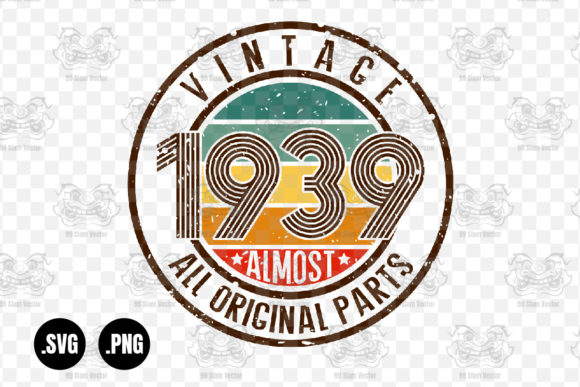
Vintage 1939 Almost All Original Parts
Let’s be real: not every “vintage” embroidery design holds up under needle and thread. I tested Vintage 1939 Almost All Original Parts on a custom linen tea towel for a local boutique’s spring collection — the kind of project where charm matters, but clarity matters more. This isn’t just another retro-themed graphic; it’s a design with quiet personality, and it reveals its strengths (and limits) fast when you actually stitch it.
A First Stitch Tells You Everything
Opening the file, I immediately noticed how much breathing room the layout gives each element — no cramped lettering, no overlapping flourishes that would melt into a muddy satin stitch. The phrase “Almost All Original Parts” sits inside a subtle gear-and-compass motif, lightly sketched, not over-rendered. That restraint is rare. It feels like something pulled from a 1930s workshop manual, not a stock vector pack. For embroidery designers, that means fewer edits before stitching: clean outlines, consistent stroke weight, and spacing generous enough to translate well into fill stitch or running stitch without collapsing.
Where It Shines — And Where It Asks for Help
I ran Vintage 1939 Almost All Original Parts on three very different substrates: medium-weight cotton twill (for embroidered patches), soft fleece-lined sweatshirts, and lightweight chambray for baby bibs. On the twill? Crisp, confident, and instantly recognizable at 3.5 inches wide — ideal for a boutique-branded patch or tote bag design. On the sweatshirt? It held up beautifully with light tear-away stabilizer and a slightly reduced density setting — the open areas in the compass motif prevented stiffness, and the lettering stayed legible even after washing.
But on the chambray bib? That’s where attention mattered. The smallest details — like the tiny rivet marks beside the “1939” — disappeared unless I increased stitch length slightly and used a finer thread. Not a flaw — just a reminder that Vintage 1939 Almost All Original Parts rewards thoughtful execution. It’s not a “set-and-forget” machine embroidery design. It asks you to consider fabric texture, hoop size, and stabilizer choice — which, frankly, is exactly what makes it feel handmade, not mass-produced.
Fabric & Fit: Know When to Lean In — and When to Step Back
This design leans into authenticity, not flash. That means it’s strong on natural fibers (linen, cotton, canvas) and mid-to-heavy knits, but less forgiving on stretchy jersey or ultra-thin voile without careful prep. I wouldn’t recommend it for curved surfaces like cap fronts unless resized to 2.25 inches max — the gear motif’s symmetry can distort if stretched across a dome. Similarly, dark fabric demands deliberate thread color choices: a warm cream or antique gold works better than stark white, preserving that vintage warmth.
For holiday embroidery or personalized gifts — say, a kitchen towel set for a mechanic’s retirement or a baby’s first birthday — Vintage 1939 Almost All Original Parts adds wit and warmth without leaning into cliché. It doesn’t scream “funny quote”; it whispers “thoughtful detail.” That subtlety builds customer trust, especially for Etsy sellers and small shop owners curating a cohesive brand voice.
Real Design Notes You’ll Actually Use
- Test first — always. Run a sample on scrap fabric matching your final product’s weight and weave. Watch how the compass lines hold and whether the “1939” numerals stay distinct.
- Check contrast early. View your thread colors against both light and dark fabric backgrounds in a printable mockup. What reads as charmingly weathered on ivory may vanish on charcoal.
- Stabilizer isn’t optional. Even on stable cotton, use medium-weight cutaway for dense areas like the gear outline. Skipping it risks puckering that undermines the design’s clean vintage vibe.
- Review stitch density. If your machine defaults to high-density fill, reduce it by 10–15% — especially in the center circle of the compass. Over-stitching here dulls the handcrafted feel.
- Inspect corners and curves. Zoom in on the SVG and PNG files. Are sharp angles crisp? Do rounded elements flow smoothly? This tells you how well the digital embroidery file will convert to smooth satin stitch paths.
- Licensing matters — double-check. Since Vintage 1939 Almost All Original Parts is listed as a Graphics product for Crafts, confirm whether commercial embroidery rights are included before selling finished embroidered patches or custom apparel at craft fairs or online.
Beyond the Hoop: Why This Design Builds Value
What makes Vintage 1939 Almost All Original Parts stand out isn’t just aesthetics — it’s intentionality. It doesn’t try to do everything. It doesn’t cram in extra flourishes to fill space. Instead, it leaves room for the material, the thread, and the maker’s hand to speak. That translates directly to perceived value: customers notice the balance, the spacing, the care in execution. A personalized gift stitched with this design feels considered, not templated.
For creative entrepreneurs, that’s leverage. Whether you’re listing an embroidered sweatshirt on Etsy, stocking aprons for a local kitchen supply shop, or designing nursery decor with gentle humor, Vintage 1939 Almost All Original Parts supports brand consistency without demanding uniformity. It works equally well as a standalone chest logo or as part of a coordinated set — say, paired with a simplified wrench icon or neutral-toned monogram.
The Bottom Line for Makers Who Stitch for Real
Vintage 1939 Almost All Original Parts isn’t flashy. It won’t dominate a social media feed with neon gradients or oversized script. But it *endures*. It stitches cleanly, reads clearly at modest sizes, and carries tone without shouting. It belongs on a well-loved apron, a gift-wrapped tea towel, a baby’s first embroidered onesie — anywhere authenticity, craftsmanship, and quiet wit matter more than trend-chasing.
If you’re evaluating this as a digital embroidery file for your craft business, ask yourself: does it reflect the standard you’d proudly put your name on? Does it enhance — rather than distract from — the handmade product it lives on? For me, the answer was yes. Not because it’s perfect, but because it’s honest, adaptable, and built to be stitched — not just downloaded.